Showing posts with label Japanese. Show all posts

Monday, December 21, 2009

YobiTsute and Keigo

Dalam Bahasa Jepun ni ada semacam "kasta" dalam percakapan. Bukan kasta sebenarnya, tapi macam memuliakan orang (honorifics), maksudnya kalau dengar orang cakap, kita boleh tau "what is the social rank of the person that he is speaking to" or at least, how he think of that person.

Honorifics, or "keigo" ni ada lagi pecahan2nya.. Kalau dalam Bahasa Inggeris benda macam nih memang tak wujud. Dan dalam bahasa Malaysia pulak, mungkin boleh ambil contoh bahasa yang digunakan oleh kerabat diraja - walaupun pada pendapat saya agak tak tepat sebab bahasa diraja ni sangatla kasta tak ingat, ada unsur2 mengangkat diri sendiri :P Manakala keigo pula lebih kepada memuliakan orang atau merendahkan diri-sendiri.

Agak complicated mula-mula belajar dulu. Tapi seronok, contohnya, kalau kita cakap dengan bestpren dan pensyarah pada masa yang sama, kita akan menggunakan semacam dua bahasa/loghat(?) walaupun tetap Japanese.

Kat kawan, kita boleh cakap "Gomen" (Sorry) atau "Wakaran" (Tak tau)
Tapi adalah satu tindakan berani mati kalau kita cakap benda yang sama kat pensyarah.
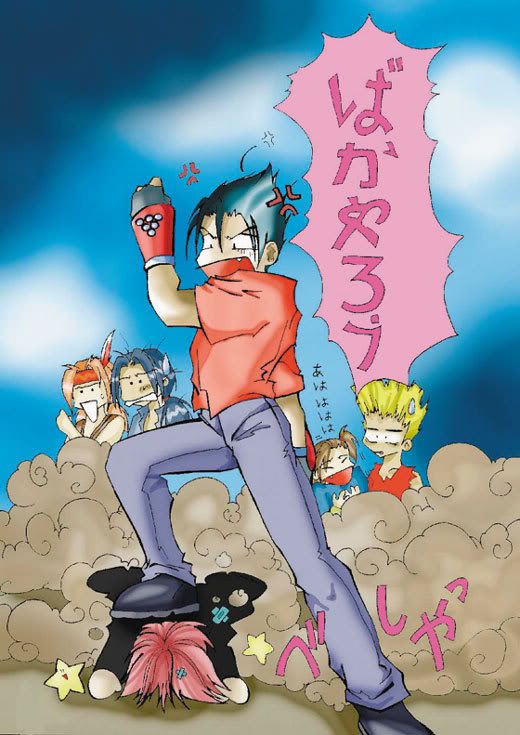

It's necessary to use "keigo" atau bahasa yang lebih polite seperti "Gomennasai" atau "Wakarimasen"...

Satu lagi benda yang tersasul-sasul nak biasakan diri mula-mula dulu ialah penggunaan -"san" di belakang nama orang. Amat kurang sopan untuk menyebut nama tanpa "san" (yobitsute) kecuali benar-benar-benar rapat...

Maka alkisahnya di sini, bila jumpa dengan Japanese first time, mestila saya guna "san" untuk ganti nama diri..n guna keigo..

Me: "S san no goshujin to okosan wa dokoni irrasyaimasu ka?"
She: "Err..Oko san ga?"
Me: "Iya...Ano.Kodomo ga"
She: "Aahh..Amarinimo teinei dakara"
Kami: (Gelak-gelak)

Me: "S san punya suami dan anak di mana sekarang?"
She: "Err..Oko san?" (cik Oko?)
Me: "Iya...Ano.Kodomo ga" (Bukan, err, anak)
She: "Aahh, bahasa (yang digunakan) amatlah sopan sangat..
Kami: (Gelak-gelak)

Dalam keigo, anak = okosan. Bahasa standard, anak = ko/ kodomo. Cik S ingatkan okosan = Oko san (Puan Oko? hehe..)

Ehehe..tu waktu first time jumpa Ms S, dia pun dah lama kat sini sampai keigo pun dia tak pakai dan jarang dengar..hehe. Jadi lawak pula, sebab sekarang bila dah rapat, jangan kata keigo, nama pun dah yobitsute (tak paggil "san") sebab nanti kalau guna "san" belakang nama dia, cik F akan usik-usik..
"Wah~ she called you S sannnnn! Wah~S sannn"
Adihh..hehe

Wednesday, November 12, 2008

Watashi

Watashi?


Sono 1:
The word "watashi" refers to "I" or "me".. which I thought is somehow familiar to many, especially those anime/jdorama lovers
Descriptions: Can be used by anyone at any occasions, formal or not

However, do you know that there were a lot more words that we can used instead of "watashi"

Sono 2:
Boku..
Description: Means me, used by men/boys.
Example: Shin chan and L (in Death Note anime) used "boku"


Sono 3:
Ore..
(sounds like Oreo, minus the final 'o')
Description: Also refers to "I" or "me", but with a more masculine image.It differs to boku (see above) since ore has a more masculine and wilder image compared to boku. Boku has a more polite/softer impression.
Example: Naruto uses "ore".


Sono 4:
Watakushi
Descriptions: A very polite form of watashi, normally used by women from high ranked society/family.


Saturday, October 25, 2008

Sukidesu!


Spelling: Sukidesu
Pronunciation: Skides! Pronunced lightly and quickly(Ski- there's)
How to use: ~ ga sukidesu (pronunciation: gak ski-there's), ga is a particle
Meaning: Like, love (verb) (BM: Sayang/suka)


Antonym: Kiraidesu Pronunced as "key-rai-des"
How to use: ~ ga kiraidesu (Same as if you use "sukidesu")

These were the few words I've taught my students during my last class. The first word is quite well known, and widely used in tv japanese dorama or animes. There is actually another word for love- Aishiteru or Aishiteimasu. Compared to 'sukides', the word Aishiteimasu itself contains a very heavy and deep meaning, and is an affectionate word. This might be the reason why 'sukidesu' is used more frequently compared to the latter, somehow comparable to the the word 'suka/sayang' while the latter might refers to 'cinta'. We are more likely to say "Saya suka/sayang dia" in many occasions compared to "Saya cinta dia."

For example:


Gohan ga sukidesu. (Go-hunk gak ski-there's)
Translation: (Saya) suka nasi.


Sakana ga sukidesu. (Sar-car-naa gak ski-there's)


Ringo ga sukidesu. (Ring-go gak ski-there's)


Japanese tends to drop the word "Watashi", or I, in the sentences. Japanese language is very easy to say, you dont have to say "I like to eat nasi/rice." Instead, saying "Like/love nasi" or "gohan ga sukidesu" is adequate and grammartically correct.

By the way, to say that you love someone, you can simply say:
"Anata ga sukidesu" --> I like/love you (Saya sayang awak)...
where, "anata" refers to "you"
or
"haha ga sukidesu" or --> I like/love mother (Saya sayang mak)

However, bear in mind that the more proper way to say that you love someone is by adding the word "no koto" after that person's names/referral names.
For example:
"Anatano koto ga sukidesu." (I like/love you)


"Anatano koto ga dai sukidesu." (I really like/love you)

Wednesday, September 10, 2008

Learn Japanese 2: a gyou, ka gyou

I dont expect one to be a perfect Japanese speaker, if they've been self studying all this while. It's difficult for them to check the pronunciation by themself. And to get them to learn all those unfamiliar symbols aka hiragana etc requires a tremendous effort and huge motivation. Thus, in this informal class of mine, im gonna do it the frendliest way possible.

The first two row of syllables are
1. "a" gyou
2. "ka" gyou

where gyou refers to row, atau baris.

so,
1. "a" gyou refers to --> a, i, u, e, o
2. "ka" gyou refers to --> ka, ki, ku, ke, ko

How to pronunce them? No, it's not what you might've been thinking. Japanese is pronunce the way it is written. Sort of "baku" pronunciation. Don't mix them up with English pronunciations/spellings...


How to write them?
Japanese is best written with calligraphy brushes. The 3 basic rules to write Japanese syllables/kanji are
1-from left to right,
2-from top to bottom,
3-IN PREDETERMINED ORDER!

Take note that even if you were to write using the commonly available pens or pencils etc, try to write/imagine as if you were using a brush.
Huhu...wish I can explain it in a more beautiful way...
How about these? -->


Monday, September 8, 2008

Learn Japanese 1: Learn Hiragana

Hiragana is the basic syllables (not alphabets) in Japanese language. For a serious Japanese learner, it is strongly advised that one should begin with learning how to read and write hiragana.

50 0n


The fifty syllables are called "Gojyuu on" or "50 sounds".
a gyou refers "a" row : a, i, u, e, o
ka gyou refers to "ka" row; ka, ki, ku, ke, ko.... and so on

If you have zero knowledge in Japanese language, and wanted to do self study on it,
start with:
1. Learn how to pronunce Hiragana syllables correctly
2. Learn how to write Hiragana

Basically, writing in Japanese is full of art and rules, and very interesting. I think I will write on it in the next entry.
For now, please note that there is no "si" (and few other syllables, to be discussed later)... thus, those with the name Siti will basically ended up sounds "Shiti"..

Thursday, September 4, 2008

Pictograph

Pictograph?
Scientifically translated, pictograph is a way of representing statistical data using symbolic figures to match the frequencies...


Talking about Japanese (or Chinese) characters, Kanji... pictograph refers to the way of representing a meaning in a symbol, later on modified to the present Kanji character which carries certain meaning and sounds.
Since I taught my students days in a week in Japanese, I had no choice but to relate and show them of how those weird sounding names came from.
Well, sort of like this...

Japanese: Days in a week
DaysJapaneseCharacters
SundayNichi youbi日 曜日
MondayGetsu youbi月 曜日
TuesdayKa youbi火 曜日
WednesdaySui youbi水 曜日
ThursdayMoku youbi木 曜日
FridayKin youbi金 曜日
SaturdayDo youbi土 曜日

So basically, now, instead of Sun, Mon, Tues, Wed, Thurs, Fri, Satur...we have Nichi, Getsu, Ka, Sui, Moku, Kin, Do [Nmemonic is: get a car so 'mak' can do nick]
where all these words refers to the elements of the world.

For example:
Getsu in Getsuyoubi is written as 月, a symbol with the underlying meaning of "Moon"...and the Kanji character 月 is originated from the shape of the crescent moon itself, before it was transformed into this --> 月.
While Nichi ==> written as 日, ==> carries the meaning of "Sun"
How? This is how...


Other characters? Take a guess...


Dont you love Japanese Kanji now? Hehe...
Posted by--"Yarukotonashi" no Sensei
 

-StiLL iN LoVe- Copyright 2009 Sweet Cupcake Designed by Ipiet Templates Image by Tadpole's Notez